Showing posts with label hearing. Show all posts

Sunday, 24 September 2017

Watch My Lips!

Hearing is not one of my strengths. I may have mentioned it before and it was certainly the subject of this post, when I spoke about the best Christmas present for people hard of hearing, and this one, written that glorious day when I became the relieved owner of my state of the art, blue tooth hearing aids. It was the day I realised that the seatbelt makes a noise when you pull it across your chest, that footsteps are audible and that when a car sounds terrifyingly close, it's probably happily zooming down an adjacent street, you've just got used to the level of engine sound which sends the message to your brain not to attempt to cross that road if you want to reach the other side.

I've also spoken about the glorious age of hearing technology in which we live and how I should be reprimanded when I moan about the negative impact of phones on our lives because, for me, the good side to the little beauties: messaging, emailing, social media and not least, bitmojis, as recently introduced to me by my eldest, far outweighs the negative effect they have on sociability and community. 
Who needs to hear when
you've got this up your sleeve?

Nonetheless, I can't pretend I am always upbeat about my lack of hearing. Being unable to participate in conversations when the environment is too much even for my amazing aids, or when, horror of horrors, they break (they are very tiny and packed with very clever technology so alas, they do need a little tlc fairly regularly) or somebody goes from whisper to full-on shout, accompanied by pained expression, with no warning of the escalation to come, so I just want to slink away, and when I'm struggling to work - then it gets me down.

Enter: a lipreading course.

Finally, after nine months on the waiting list, my first class was today. I was ridiculously excited about the life-changing, or at least, life-improving, potential for this. But I was also nervous. The stakes were high. I'd been told the art of lipreading is tricky and at the very least, I'd need to dedicate a year to this new skill, probably more. I was, and am, prepared for that. If it works it will be hours enormously well spent. But with such high hopes, I knew I'd be disappointed crushed if ten minutes in I had that sinking feeling that this might not be the miracle I'd hoped it could be. I'd also missed the first week of the course due to holiday and if I've got to be a newbie, I'd rather be a newbie amongst newbies.

So, after following Maps on foot to a street I already know but 'just to be sure' (I never learn), I made only two wrong turns and was still outside the classroom ten minutes early. Ten minutes early for me, is half an hour in punctual people's worlds. I was quite proud of myself; the extra ten minutes would allow time for me to meet the teacher, make payment and apologise in person for missing the first week. Not so, my class is full of punctual people. Only two students arrived after me and one of those had been stuck on a five mile stretch of the A1 for two hours. No matter, everybody smiled kindly, the teacher welcomed me several times and I settled myself in, making my first mistake before the lesson had officially started, by answering the teacher whilst rummaging in my bag. You'd think I'd know better. She asked the question again, and I realised the teacher's hearing was even worse than mine.

Quickly, I began to realise that I'd entered a meeting room unlike any other I'd ever been in. Everybody waits to speak; no two people speak at one time. If somebody doesn't hear, their neighbour softly taps them on the arm and repeats it to them, and everybody is quiet while they do. Nobody worries about saying 'pardon' – none of the 'two pardon lives' here, where instead of the third 'pardon' it's preferable to simply nod or shake the head (a scrutiny of the speaker's facial expression is a fairly reliable guide to which way to go), allowing the two or more of you to move smoothly away from the troublesomely awkward conversation – no, here, you can pardon all you like. No background radio, no noisy fans and the blinds, crucially, were drawn. I joke that if I could carry out my life in the soundproofed booth of the audiologist's testing centre, I wouldn't need hearing aids, and this room came a very close second to that. I should add that once comfortable, I found myself discretely checking out everybody's hearing aids – which is tricky as they're so tiny these days – so, let it never be said that I don't know how to party.

On with the lesson and we talked about barriers to effective lipreading and how to get around them, practised comprehension of a passage about the history of London's coffee houses with the teacher soundlessly mouthing each short sentence – I understood enough to know that it wasn't Starbucks who started it all - and practised the number six (it's the hardest to spot) as well as the 'ff' sound.

In short, in no particular order, this is what I learnt:
  • If I really concentrate, focus, clear my mind of the other rubbish, I can already understand a fair bit.
  • Ask your friends if they'll kindly let you sit with your back to the window in a restaurant so that you don’t have to wrestle with the light casting shadows over their faces.
  • 'Coffee' is easily mixed up with toffee, fluffy, muffly, wavy, banoffee, lovely and jiffy – but surprisingly not so much in context – which is comforting to know.
  • 'Coffee' looks very different to 'tea' and so you won't end up with the wrong drink, even if you can't catch who's paying.
  • Our teacher developed almost total deafness over the course of twenty years and communicated well through lipreading, until she had a cochlear implant a few years ago. It's wonderful to know she could manage but lipreading doesn't help you hear the birds or music, does it? This is one of those occasions where you have to love technology.
  • The first coffee houses grew up in London in the 1600s and by the 18th century, there were over 3,000 of them.
  • If you feel able, ask the person with whom you're speaking to remove sunglasses, a hat, hair over the eyes, perhaps their hand in front of their face, as these all affect your ability to lip read.
  • Charles 2nd didn’t like coffee houses because politicians gave away all their secrets chatting in them.
  • The art of understanding the spoken word through reading lips is written, 'lipreading' as opposed to, 'lip reading'.
  • Artificial light is better for lipreading than natural light.
  • Women didn't like coffee houses because the, 'new-fangled, abominable, heathenish liquor called "coffee" had transformed their industrious, virile men into unfruitful, babbling layabouts who idled away their time in coffee houses', or so said the Women's Petition in 1674. It made no difference and yes, that section was written down for us. Try me again in a couple of years on that one.
  • Certain people are easier to lipread than others.
  • I am by far the worst in the class. This is good because the others have been coming for months if not years and thus proof that it is possible to learn this stuff.
  • If you've been all-consumed with getting out of the door on time for your class and have thus forgotten about breakfast, none of the other students, nor the teacher, will hear your stomach rumbling and crashing around. 


So, did I enjoy my first class? Certainly. Will I be going back? Absolutely. Will I develop the skill to read what people are saying on the other side of the room?

Well, that would be telling, wouldn't it…??

Friday, 23 December 2016

The Bottom of the Swimming Pool

I had a letter in the post today from Louise Goldsmith, a 21 year old who spoke so eloquently and soulfully it pulled at my heart. I don't know Louise but I can relate to her story. She has had severe hearing loss since she was seven years old and the letter is a candid account of this 'hidden disability' as she calls it, how she'd like to say her lack of hearing hasn’t adversely affected her life in any way, but, sadly, she isn't able to do this.

It's an insight into a world I know.

I'm not sure my hearing loss is as profound as Louise's – yet – and it certainly wasn't as bad when I was in my twenties, but it is a constant stress. I'm helped by amazing technology, not least my discrete Bluetooth hearing aids (I wrote about their maiden outing, here), the crystal clear headphones for the TV and the addition of subtitles. And I thank my lucky stars that I live in an age when I can carry out my entire communication through messaging of various sorts without ever having to put any of us through the ordeal of having to speak on the phone. Cochlear implants and Bone Anchored Hearing Aids are a possibility for the future and thus I live in hope that I won't become the little old lady in the corner whom everyone ignores, because it's easier.

Nonetheless, it's isolating not being able to hear and it affects every part of life – work and play. It's exhausting when every conversation is a missing word quiz and depressing when people think you are stupid and that you don't get the joke you didn't hear.

But it isn't all bad.

I have particularly noticed recently, probably because my hearing has plummeted lately, that my family have strategies to help me join in and that these have become automatic. It means that in my home, as long as I have my hearing aids, I don't have too much difficulty communicating. Reading Louise's flier, I thought it might be useful to share some of these tips before the typical large group, multi-generational, terrifyingly full of background noise festive party season is fully upon us. I hope it might be helpful to those who hear well and those who don't.

Here goes!

Please don't SHOUT! I totally understand how frustrating it is to be with someone whose every second sentence is, 'Sorry, I missed that,' and I understand the instinct to raise our voice. However, for many of us, it isn't that a voice is quiet so much as the speech is muffled.

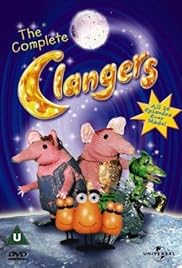
The Clangers Poster
To try to give a picture of what it's like, imagine yourself tucking into your Christmas dinner whilst attempting to converse with your neighbour, all at the bottom of a swimming pool. New Year's Eve party? Add the Clangers to the bottom of the pool, dispersed around you, all talking loudly in sounds you can't understand but conspiring to drown out your neighbour nonetheless. If the person with whom you were trying to communicate simply shouted, it wouldn't make any difference to your comprehension. If however, they turned to face you and really enunciated their words, using more pronounced facial gestures, then you'd have a chance of understanding.

The trouble with shouting, apart from the fact it often doesn't help, is that it's really not very nice to be shouted at - particularly when everyone else is speaking at normal pitch. Because with the shout comes the facial expression: the screwed up, pained face. I know the intention is not to make the interlocutor feel awful but it makes me want to crawl away. After all, the conversationalist is clearly intensely annoyed (people only shout when they're cross, don't they?) and you are responsible for ruining their day, you and your sub-standard hearing - so why would you choose to hang around? If somebody shouts, I bluff that I've heard and feign a sudden need for the Ladies. 

Alter rather than Repeat: Often, people who struggle with their hearing miss the first word, or a particular word, and can't get the gist of the sentence because of that. Sometimes, the conversation can be saved simply through repeating it directly to the person in question but if this doesn't work, paraphrasing might be all that's needed to get around the troublesome word.

Face your Partner: For all of us, not just the hard of hearing, understanding speech is about so much more than the actual words spoken. We glean the sense of it through context and the 'music and the dance'. I remember a first hearing consultant saying to me shortly before I wore hearing aids that when he looked at my audiogram - a graph which represents the picture of an individual's ability to hear different sounds - he couldn't understand how I could possibly function but, he was quick to add, he saw this all the time. He said that it was a reminder to us that communication is about much more than words. In fact, it's oft quoted that 93% of what we hear is communicated through everything but the words. According to a certain Professor Mehrabian in 1971, 55% of communication is in the body language, 38% is in the tone of voice with only 7% being the words spoken.  

Now, the exact figures have since been rebuked but I think there is truth in the message. Certainly, that first consultant was convinced that was how people with hearing loss could manage surprisingly well. I would also suggest that people who are hard of hearing whilst perhaps not so good at hearing changes in tone of voice, might be even better at reading body language than this stat states.

And living proof of this is that I understand so much better if I face the person with whom I'm speaking. I don't officially lip read (although I'm about to learn and am ridiculously excited about the potential for my new skill) but matching the lips to the muffled sounds is often all I need.

Don't Walk Away! For the same reason, I wouldn’t even attempt to have any meaningful conversation with your back to whom you're speaking as you walk away.

Come and Ask! Likewise, my family have largely learnt that there is little point shouting from another room when they've been doing 'boys-or-teen-looking', in the hope I'll come scurrying to find said not-really-lost item. Even if I can hear the call, I won't know who or where it's coming from nor what it's about. If I'm really needed, my family have to come to me.

Well, we have to have some perks, don’t we…?

It does matter: And finally, and oh so importantly, please, please don't say, It Doesn't Matter. Because it really, really does. What might seem a seemingly inconsequential throwaway comment to you, is actually the stuff which makes the world go around. It's the context, it's the relationship, and nothing is more depressing than being told that what everybody else heard, isn't important enough to repeat to you. It's isolating and the more it happens, the more I become that little lady in the corner of the room, in the corner of life.

My hearing could be worse, I could be profoundly deaf, but it is a problem. For me, and everybody with hearing loss, please practise your very best diction this Christmas and look into our eyes when you speak.

That would be our very best Christmas present and an enormous helping hand through 2017.


PS There is good news for poor hearing. Increased deafness goes hand in hand with an ageing population and scientists and businesses have taken up the challenge. Breakthroughs are coming thick and fast and I am very hopeful for my hearing future and that of everyone currently struggling. Action on Hearing Loss (formerly the RNID) is a charity helping to find cures. If you haven't sent Christmas cards this year and keep meaning to get round to a charity donation instead, please consider supporting Action on Hearing Loss. More information here  

Tuesday, 15 September 2015

Attached to the Phone

It’s term time again which can only mean one thing: back to ironing on Monday and Friday mornings. I like a deadline so the deal is that I have to get it all done before 9am when I start work. It commences around 7 with brief interludes to push my children through the door and into the arms of the school bus, to load forgotten cereal bowls into the dishwasher, to put the washing on - lest I should have no clothes to iron in a few days’ time.

And to have a flit around Twitter.

I like Twitter because people can be very funny and in 140 characters they can be even funnier. It’s also where I hear about blogs and writing competitions – so I can even pretend it’s work – and where fellow tweeps share writing successes and woes which is the closest I get for hours, sometimes, to having a chat with colleagues at break. I also like to have a paddle around Facebook but we’ll leave that one there before you raise an eye at the suggestion that this may be something akin to work.

We got back from our summer holiday on the eve before school began for the new term. I love being on holiday but I also love coming home, even though it’s with a tinge of panic about getting back-to-it, that I’ve forgotten how I work and what I need to do. It’s a real life recurring dream for me. As is customary, I’d compiled my to-do list in the car as we left the airport. Who am I kidding? I’d been adding to my to-do list all holiday and this time I took out my pen to add some things that had needed doing which I’d already done and could thus be ticked off. (Some of you won’t understand this and I salute you.) The list had done the trick: no need to panic. The house was clean, only the aftermath of a seven week period of ironing on a need-only basis to contend with, the freezer was packed with food and the fresh stuff was arriving by those kind home-delivery people with their lively suggestion of substitutes just to keep life interesting.

Let’s just say, the stench which hit us as we opened the front door was not a dead animal (or family of, I’d decided, with one still limping to a better place, via the bottom of my bed), nor was it the entire contents of the ‘cycling drawer’, although we do appreciate that I have now washed every pair of gloves, neoprene socks and avoid-washing- unless-smelling-like-dead-animals shower-proof- jackets. No, after an hour of false starts, my husband was the unfortunate soul who discovered the source of the foul smell. We’d left the freezer door ajar all holiday; our rammed full freezer, boasting fish fillets after the lovely man from South Shields had paid his annual visit and persuaded me that forty packs of assorted flavours were much better value than twenty. There were a couple of blocks of stilton in there, too. 

I would like to say a public thank you here to my husband for launching into the first and by far the worst of the three all-over freezer cleans, including all the pipe work and the floor below where putrid fish juice had seeped.

And the home shopping delivery didn’t turn up.

Thankfully, if a little ironically, we’d bought fish and chips on the way home so nobody went hungry for this tale. And our milkman had delivered so we could have a cup of tea.  Lots of cups of tea. You see, there are perks to a by-gone age.

On holiday we had no Wi-Fi. Actually, we had a small allocation of Wi-Fi but my children’s Snapchatting needs, and thus desire for the holiday quota, was greater than mine. It meant that I had three weeks without the internet.

Now, I’m afraid that the freezer debacle with its laborious insurance claim and urgent need to buy fish, or the distinct absence of ironing fairies – I know, I know, I really should have done the uniform before midnight of the night before the new term – or even the time spent having a couple of coffees with people I hadn’t seen for years (ok, weeks) is not to blame for the fact that I am still chasing my tail (or should I say, ‘tale’) a week after our return. I’m afraid, dear readers, the cause is Wi-Fi, or to be precise: social media.

I’ve lamented before about the time sap that is this fairly recent phenomenon of our need to share and share again our lives, but being without social media on holiday was a different revelation this time. I had a wonderful holiday. But I actually missed my online communication.

Even though I didn’t realise it until I got home.

Partly due to my woeful hearing making phone conversation both for me and the poor person on the receiving end a little trying, but mainly due to living in a world where most people of my generation and younger are more likely to message than make a phone call, contact using the internet has become my number one way of keeping in touch. It’s a sad admission that I use any time I might have spent speaking on the phone, on-line, but other people are doing the same. Even if I wanted to go back to sitting on the stairs in the hall à la 70s, attached to a phone line via a curly wire connected to the cheese wedge on the wall, and when I was only on the phone, when I was 'on the phone', I’m not sure many other people would have the time or inclination to indulge me. 

When my Wi-Fi returned and I logged into Facebook and Twitter, read the funny little quips and personal messages, it made me smile. There is something undoubtedly reassuring about sharing online that your house stinks of rotten fish, your food delivery hasn’t turned up and you’re going to be here for the foreseeable because you couldn’t be bothered to do the ironing over the school holidays - and learning that you’re not alone. There is a certain comfort in knowing that even when you were away, you weren’t forgotten. And there’s something quite heartening about realising that a three week world without internet was fun, but only that. It wasn’t superior, just different.

I have a love/hate relationship with technology. I spend most of every day on the computer and am the most complaining and exacting of companions: how dare you crash? How dare you not allow me to ‘save’, you’re a computer, that’s what you do! Yes, I should learn how to use the new software but I don’t have time, so make it work anyway, if you wouldn’t mind. I always said I would happily ditch the computer and go back to letter writing and postcards, to queuing in the post office three days before deadlines to make sure my work reached its recipients safely, to sitting in the library with my amassed questions on post-it notes. And I probably would go back to this world, if everyone else would join me.

But the internet is here to stay and thanks to a period of abstinence, our relationship has deepened a little. I’m off to joyfully post this on-line, appreciating the seconds it will take to do it, whilst repeating the mantra that I will not complain about technology, that I will not have unrealistic expectations, that I will happily use social media but ONLY when I’m not working.

I have just removed my mobile phone to the hall.

How about you? Are you a technology lover or a fighter? And how do you manage your time?