Showing posts with label Action on Hearing Loss. Show all posts

Tuesday, 16 June 2020

Behind The Mask

On a sun-kissed afternoon in our garden a few weeks ago, the four of us were toasting the hubby’s Big Birthday with three other screens - thanks to that technology which the world has embraced like a lo-alcohol beer. Zoom! A necessary and viable alternative to a hug and a coffee, but not our first choice of communication in normal circumstances. There were the siblings and families dressed up, with fizz and glasses in hand and the hubby’s parents, their faces we’d not seen for over eight weeks, squeezed around their iPad screen, communicating as easily as if it were a 70s rotary telephone. And yet prior to March of this year, the only ‘zoom’ any of us would recall was in an exclamation bubble on a page in the Beano.

Obviously, I couldn’t hear what anyone was saying but nonetheless, it was a touching moment and one of the many great ones from the madness of 2020 which will stay with me. We were celebrating together. We were all a bit giddy for many reasons, not least the bizarre nature of partying Covid-style. It was a moment.

It's funny how we adapt. Indeed, I find it heart-warming and emboldening how humans seem to be able to adapt to most things, given time. It gives me confidence in times of stress that we can get through the difficulties that present themselves to us all in their many and varied ways: we’ve been here before. We can do this.

And I remain optimistic that the world will reach the other side of this pandemic, dust itself down and even retain some of the positives of the experience. That said, I realise it’s easy for me to say this. I am fortunate, my experience of Covid-19 thus far, has been so much easier than it has been for many others. I am very conscious of that.

But there is one aspect of Covid-19 life which has been particularly troubling me, and seeking updates on the wearing of masks and other face coverings, has become my new obsession.

People have different views on the effectiveness of home-made and non-surgical grade face coverings, but that’s for another day, and certainly for somebody better briefed on the matter than I am. What is clear, is that from 15 June when the wearing of face coverings on public transport became mandatory in England (recommended in the rest of the UK) covering our mouth and nose is going to be part of our ‘new normal’ routine for at least the next few months.

There are inherent difficulties in communication when we cover our faces, not least for the 1 in 6 of us who are hard of hearing. For those of us who use lipreading either with, or instead of, poor hearing, communicating with someone whose mouth is covered becomes at best a one-way street. Fabulous as my hearing aids are, they don’t work on their own. I cannot begin to communicate when I can’t also see somebody’s lips, and to a lesser extent, their whole face.

I’m minded to tell you about the time I travelled from York to London instead of Newark on a fantastically crowded train, only becoming aware it was the wrong train when I found somebody sitting in my reserved seat. Oh no they weren’t. It wasn’t an enormous hardship once I’d sorted out onward travel and alerted those waiting for me, and had the assurance that I would receive a full refund. But the situation was solely down to the fact that the platform screen hadn’t updated, coupled with Tannoy announcements being as much use to me as someone talking with a sock in their mouth, from the next village.

Lipreading-friendly masks for sale.
Lots of different patterns
More seriously, if you are faced with that type of scenario every time you leave the house, it adds another layer of stress, at the very least. Add to that the terribly depressing feeling of being none the wiser after having a humiliating conversation with a friendly fellow passenger, or member of staff, or anybody with whom you come into contact who leaves the scene thinking you are either rude, or stupid, or both, and you’ll see how situations where you run the risk of not hearing are no fun at all. Sometimes staying home seems a lot easier. And this is one of the reasons why isolation and loneliness for people with hearing difficulties is a very real threat. None more so than now.

But read on, because this is a much more positive post than it started out a few weeks ago. There are solutions to the covered mouth predicament; we just have to know they are there and be encouraged to use them.  

Those wonderful people at Action on Hearing Loss have been successful in their campaign that face coverings should not be mandatory for anybody ‘travelling with or providing assistance to someone who relies on lipreading to communicate.’ 
This is great news on an individual communication level. You can read more about the legislation here.

Then there are the wider circles. I am so happy to report that some fabulous individuals and organisations have set themselves the task of inventing an alternative mask that shows the lips and mouth. Indeed, as one sign language interpreter described: so you can see the smile.


A transparent mask isn’t perfect. It will need demisting, for example (but cloth masks get hot and sticky, too). I’m also not sure whether the sensitive issue of, how shall we call this, the potential unsavoury display of what comes out of all our mouths – let’s just leave that one there – has been solved, but it’s enormous progress in the right direction and if nothing else, a transparent covering could be worn for short periods, when communication with others was imperative. And the more we embrace the early prototypes, the more time and investment will be put into more usable, long-term versions going forward.

With the designs available, the hard part is done. Now we need to encourage everyone to commit to this kind of face covering, even those with 20/20 hearing, please! After all, the wearing of any face covering during the pandemic is about helping the other person, not ourselves. If we all buy or make masks which show the mouth where remotely possible, this potential crisis for lipreaders will be largely averted.

Instructions are in sign language.
A bit more technical, but worth a look
You know, these transparent masks take a bit of getting used to. But then, the traditional cloth masks and scarves generally look a little odd to me at the moment. I can’t help thinking that once we get used to a partially transparent mask, that we might all prefer to see people’s mouths and more of their faces and the ‘music and the dance’ that shows the real meaning when we speak.

After all, if we can embrace birthday celebrations crowded around small screens with three generations hundreds of miles apart, I am pretty confident we can adapt to transparent face coverings.

Thanks for visiting the blog. Do let me know of any face covering creations or stellar purchases. Happy face coverings to you all😊


Click on the captions in the selection of pictures in this post for links to just a few of the to-purchase, home-made and more technical options already out there.

Update! Due to a fabulous response to the post - so much enthusiasm for transparent masks, thanks so much! - I've been looking for other places to buy transparent masks, and found loads at Etsy 

Don't forget Just Smile, the fabulous wife and husband team who make all their masks (currently - they've been inundated!) and as mentioned above. 


An enormous thank you to the very kind people who have listened to my fears and sent various articles and links. I, we, appreciate you, appreciating our plight!


Friday, 23 December 2016

The Bottom of the Swimming Pool

I had a letter in the post today from Louise Goldsmith, a 21 year old who spoke so eloquently and soulfully it pulled at my heart. I don't know Louise but I can relate to her story. She has had severe hearing loss since she was seven years old and the letter is a candid account of this 'hidden disability' as she calls it, how she'd like to say her lack of hearing hasn’t adversely affected her life in any way, but, sadly, she isn't able to do this.

It's an insight into a world I know.

I'm not sure my hearing loss is as profound as Louise's – yet – and it certainly wasn't as bad when I was in my twenties, but it is a constant stress. I'm helped by amazing technology, not least my discrete Bluetooth hearing aids (I wrote about their maiden outing, here), the crystal clear headphones for the TV and the addition of subtitles. And I thank my lucky stars that I live in an age when I can carry out my entire communication through messaging of various sorts without ever having to put any of us through the ordeal of having to speak on the phone. Cochlear implants and Bone Anchored Hearing Aids are a possibility for the future and thus I live in hope that I won't become the little old lady in the corner whom everyone ignores, because it's easier.

Nonetheless, it's isolating not being able to hear and it affects every part of life – work and play. It's exhausting when every conversation is a missing word quiz and depressing when people think you are stupid and that you don't get the joke you didn't hear.

But it isn't all bad.

I have particularly noticed recently, probably because my hearing has plummeted lately, that my family have strategies to help me join in and that these have become automatic. It means that in my home, as long as I have my hearing aids, I don't have too much difficulty communicating. Reading Louise's flier, I thought it might be useful to share some of these tips before the typical large group, multi-generational, terrifyingly full of background noise festive party season is fully upon us. I hope it might be helpful to those who hear well and those who don't.

Here goes!

Please don't SHOUT! I totally understand how frustrating it is to be with someone whose every second sentence is, 'Sorry, I missed that,' and I understand the instinct to raise our voice. However, for many of us, it isn't that a voice is quiet so much as the speech is muffled.

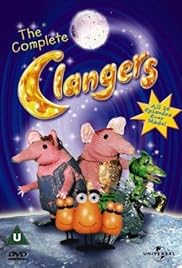
The Clangers Poster
To try to give a picture of what it's like, imagine yourself tucking into your Christmas dinner whilst attempting to converse with your neighbour, all at the bottom of a swimming pool. New Year's Eve party? Add the Clangers to the bottom of the pool, dispersed around you, all talking loudly in sounds you can't understand but conspiring to drown out your neighbour nonetheless. If the person with whom you were trying to communicate simply shouted, it wouldn't make any difference to your comprehension. If however, they turned to face you and really enunciated their words, using more pronounced facial gestures, then you'd have a chance of understanding.

The trouble with shouting, apart from the fact it often doesn't help, is that it's really not very nice to be shouted at - particularly when everyone else is speaking at normal pitch. Because with the shout comes the facial expression: the screwed up, pained face. I know the intention is not to make the interlocutor feel awful but it makes me want to crawl away. After all, the conversationalist is clearly intensely annoyed (people only shout when they're cross, don't they?) and you are responsible for ruining their day, you and your sub-standard hearing - so why would you choose to hang around? If somebody shouts, I bluff that I've heard and feign a sudden need for the Ladies. 

Alter rather than Repeat: Often, people who struggle with their hearing miss the first word, or a particular word, and can't get the gist of the sentence because of that. Sometimes, the conversation can be saved simply through repeating it directly to the person in question but if this doesn't work, paraphrasing might be all that's needed to get around the troublesome word.

Face your Partner: For all of us, not just the hard of hearing, understanding speech is about so much more than the actual words spoken. We glean the sense of it through context and the 'music and the dance'. I remember a first hearing consultant saying to me shortly before I wore hearing aids that when he looked at my audiogram - a graph which represents the picture of an individual's ability to hear different sounds - he couldn't understand how I could possibly function but, he was quick to add, he saw this all the time. He said that it was a reminder to us that communication is about much more than words. In fact, it's oft quoted that 93% of what we hear is communicated through everything but the words. According to a certain Professor Mehrabian in 1971, 55% of communication is in the body language, 38% is in the tone of voice with only 7% being the words spoken.  

Now, the exact figures have since been rebuked but I think there is truth in the message. Certainly, that first consultant was convinced that was how people with hearing loss could manage surprisingly well. I would also suggest that people who are hard of hearing whilst perhaps not so good at hearing changes in tone of voice, might be even better at reading body language than this stat states.

And living proof of this is that I understand so much better if I face the person with whom I'm speaking. I don't officially lip read (although I'm about to learn and am ridiculously excited about the potential for my new skill) but matching the lips to the muffled sounds is often all I need.

Don't Walk Away! For the same reason, I wouldn’t even attempt to have any meaningful conversation with your back to whom you're speaking as you walk away.

Come and Ask! Likewise, my family have largely learnt that there is little point shouting from another room when they've been doing 'boys-or-teen-looking', in the hope I'll come scurrying to find said not-really-lost item. Even if I can hear the call, I won't know who or where it's coming from nor what it's about. If I'm really needed, my family have to come to me.

Well, we have to have some perks, don’t we…?

It does matter: And finally, and oh so importantly, please, please don't say, It Doesn't Matter. Because it really, really does. What might seem a seemingly inconsequential throwaway comment to you, is actually the stuff which makes the world go around. It's the context, it's the relationship, and nothing is more depressing than being told that what everybody else heard, isn't important enough to repeat to you. It's isolating and the more it happens, the more I become that little lady in the corner of the room, in the corner of life.

My hearing could be worse, I could be profoundly deaf, but it is a problem. For me, and everybody with hearing loss, please practise your very best diction this Christmas and look into our eyes when you speak.

That would be our very best Christmas present and an enormous helping hand through 2017.


PS There is good news for poor hearing. Increased deafness goes hand in hand with an ageing population and scientists and businesses have taken up the challenge. Breakthroughs are coming thick and fast and I am very hopeful for my hearing future and that of everyone currently struggling. Action on Hearing Loss (formerly the RNID) is a charity helping to find cures. If you haven't sent Christmas cards this year and keep meaning to get round to a charity donation instead, please consider supporting Action on Hearing Loss. More information here